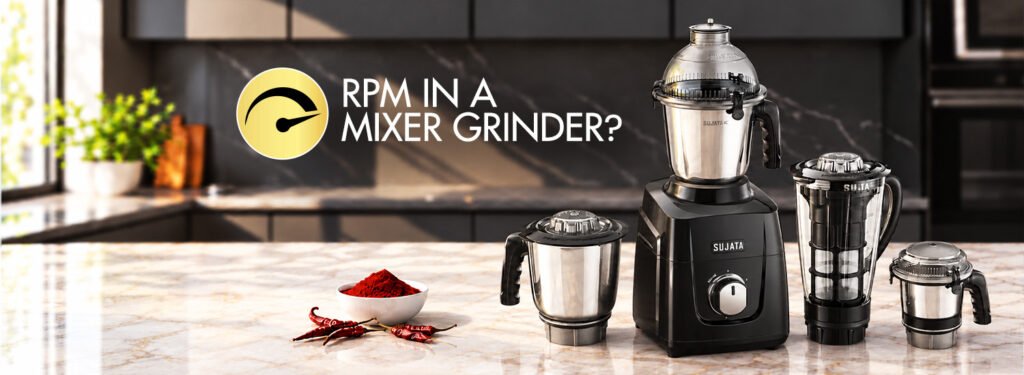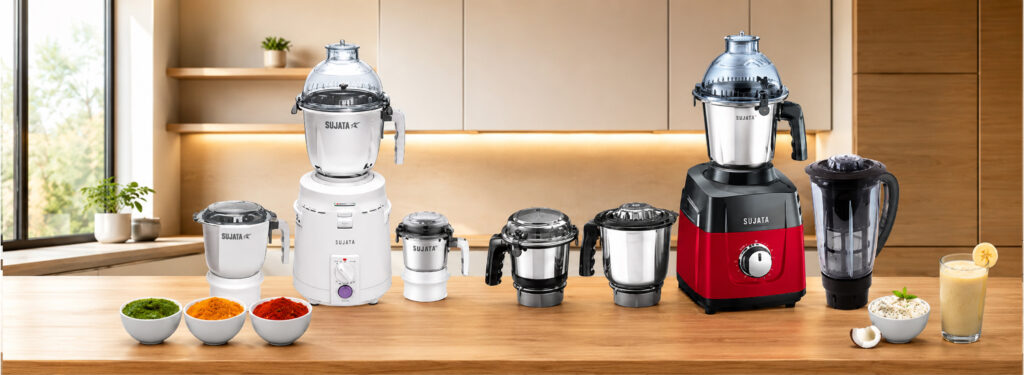

If you’ve ever browsed for a kitchen appliance and noticed a spec that reads “22,000 RPM” or “24,000 RPM,” you’ve already encountered one of the most important, and often most misunderstood, numbers in a mixer grinder’s feature list. Understanding mixer grinder RPM is key to making a confident, informed purchase that serves your kitchen for years to come.
This guide breaks down what RPM means, how it works in your appliance, and why it matters for an Indian Kitchen.
RPM: What It Is and Why It Matters
RPM stands for Rotations Per Minute. For a mixer grinder, it refers to the number of complete rotations the cutter blades, completes in a single minute.
The more RPM a machine has, the faster it spins the blades, working on your food particles with maximum efficiency in the shortest possible period of time. If you plan to grind dry spices, make a smooth coconut chutney, mix up some batter for idlis or dosas, or blend your daily dose of fruits, the RPMs of your mixer play a significant role.
A domestic mixer grinder typically operates between22,000 and 24,000 RPM, which covers the full range of standard Indian cooking requirements, from coarse spice mixes to silky-smooth pastes.
Why Mixer Grinder RPM Matters for Indian Cooking
The Indian kitchen is based upon grinding. Whole spices, soaked dals, fresh coconut, ginger and garlic paste, and batter are some of the many demands of the kitchen. A machine that cannot maintain high RPM consistently while performing its function will find it difficult to grind harder products. Here’s what RPM directly impacts:
- Grinding fineness: Harder spices such as black peppercorns, dried chillies, and raw turmeric tend to put up a fight. The faster blades will ensure that they are all ground fully into a fine powder for every use, rather than half-ground spices that need a second grind.
- Consistency under load: A full jar of soaked dal or a heavy dry masala blend puts real pressure on the motor. A machine with strong RPM and good motor power doesn’t slow down or struggle under that weight; it grinds the same way whether you’re making a small green chutney or a big batch of garam masala.
- Speed of preparation: At 22,000 RPM or higher, ingredients that once required minutes of repeated grinding are processed in seconds, preserving the natural flavours and aromas of fresh spices that slow or prolonged grinding can diminish.
RPM and Motor Technology: The Connection You Must Understand
Most buyers focus only on RPM, but that’s just half the story. Here’s what matters:
- High RPM alone isn’t enough. If the motor doesn’t have the power to back it up, blade speed will drop the moment you load the jar with heavy ingredients.
- The motor’s build quality decides real-world performance. Wattage, winding quality, and how the motor is engineered determine whether that RPM holds steady or fades under pressure.
- Double Ball Bearing motor. Sujata appliances has Double Ball Bearing motor, which helps reducing friction, heat build-up, and wear over time.
- Stable performance even during long grinding sessions. The motor doesn’t slow down, whether you’re grinding a quick chutney or running a full 90-minute cooking session.
- Less wear means longer life. The precision engineering in the motor and cutter assembly adds up to an appliance that stays consistent and trouble-free for years, not just months.
Continuous Operation and Long-Term Reliability
In cases of Indian homes where cooking is done on a large scale and daily, there is an additional consideration regarding RPM. The Sujata mixer grinders come in for nonstop use for up to 90 minutes, which is quite impressive considering the type of machine. This machine is thus ideal in cases where you are cooking on a large scale, either at home or in a restaurant setting.
This kind of reliability is the result of years of engineering refinement, precision-machined cutter blades set at exact angles for maximum grinding efficiency, pre-oiled felt bushes in the cutter assemblies for lasting smoothness, and motors wound with 100% copper for consistent performance across thousands of hours of operation.
A Practical Mixer Grinder Buying Guide: What to Check Beyond RPM
When evaluating a mixer grinder for home use, RPM is your starting point, not your finishing point. Here’s a quick mixer grinder buying guide checklist:
- RPM range: Choose a mixer grinder with an RPM range of 22,000 to 24,000.
- Motor power and quality: Copper windings and ball bearing construction determine how reliably that RPM is sustained.
- Continuous operation rating: A machine rated for 90 minutes of continuous use handles heavy loads without stress.
- Blade engineering: High-tensile stainless-steel blades, machined at precise angles, make a measurable difference in grinding quality.
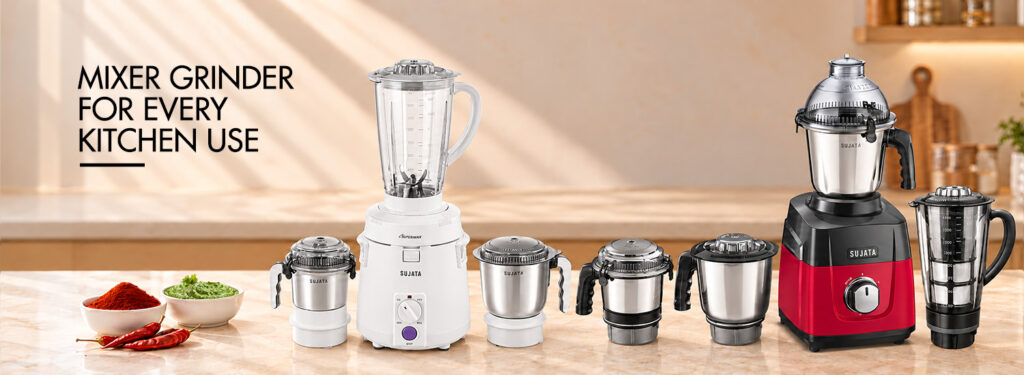
- Jar compatibility: Ensure the jar sizes and materials suit your cooking volumes, dry grinding, wet grinding, and blending, as each has different requirements.
- Build durability: Look for robust couplers, durable jar handles, and a stable motor base that doesn’t vibrate excessively during operation.
Trusted Performance, Built to Last
Ask anyone who has been cooking Indian cuisine, and you’ll hear that, somewhere along the way, Sujata has played an indispensable role. For generations in home kitchens and small-scale caterings, this sort of steady service doesn’t come from advertising. It comes from experience. The truth is, the best mixer grinder for home use isn’t the one with the flashiest number on the box. It’s the one that still delivers the same smooth masala paste on a Sunday morning, three years later, as it did on day one. That consistent, everyday dependability is what Sujata has always been engineered for.
So, when you’re buying a mixer grinder, think of it less like a purchase and more like a long-term kitchen partnership.