
A quick breakfast can make busy mornings easier, and toasted bread is a simple favourite in many households. From bread with butter and jam to toast served with eggs, it is an easy option when you want something convenient. A pop-up toaster helps you prepare evenly toasted bread without having to stand near the stove and monitor it throughout the process. With the right appliance, preparing breakfast can become a simpler part of your daily routine.
However, choosing a toaster involves more than looking at its appearance or price. Slot size, browning settings, capacity, safety features and ease of cleaning can all affect how convenient it is to use. The right choice depends on your household size, the type of bread you usually eat and how often you prepare toast. This toaster buying guide explains the important features to consider before purchasing and explores Sujata Appliances’ toaster range to help you make an informed decision.
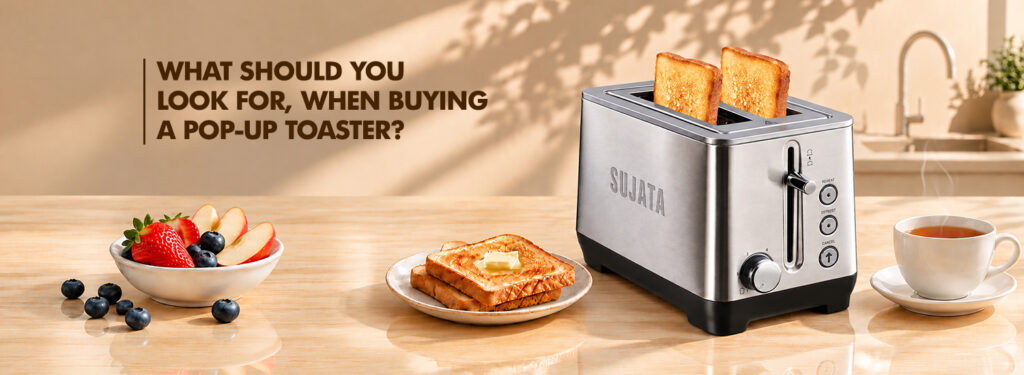
What Should You Look for When Buying a Pop-Up Toaster?
Before comparing different models, think about your everyday breakfast habits and the features you are likely to use regularly. A toaster with several additional functions may be useful for some households, while a simpler model may be sufficient for others. Paying attention to practical details such as slot dimensions, capacity and cleaning requirements can help you find an appliance that fits your kitchen without paying extra for features you may not need.
1. Choose the Right Number of Slices
The number of slices a toaster can prepare at a time is one of the first things to consider. Two-slice toasters are generally suitable for individuals, couples and smaller households, while four-slice models can be more convenient for families that prepare breakfast together. Choosing the right capacity can help you save time in the morning, especially when several people need breakfast before leaving for work or school.
Before deciding, consider how many slices you usually prepare in one sitting and how much counter space you have available. A two-slice model may be practical if you make toast for one or two people, while a four-slice toaster can reduce the need to repeat the toasting cycle for a larger household. Sujata Appliances offers both options, with the PT11 designed for two slices and the PT12 designed for four. This gives you a choice based on your household’s needs rather than capacity alone.
2. Check the Slot Width and Depth
Standard sliced bread may fit comfortably into regular slots, but thicker slices can be difficult to insert into narrow openings. Extra-wide and deep slots offer more flexibility for different bread sizes, making them worth considering if you prefer thicker slices or regularly buy different varieties of bread.
When comparing models, check both the width and depth of the slots rather than relying only on the product’s overall size. The bread should fit comfortably without being forced into the opening, and it should be easy to remove after toasting. Sujata’s PT11 and PT12 feature slots measuring 40 mm wide and 120 mm deep. These dimensions can help you assess their suitability for the bread you usually eat. Always follow the manufacturer’s instructions and avoid inserting oversized items that could become stuck.
3. Look for Adjustable Browning Settings
People have different preferences when it comes to toast. Some enjoy lightly toasted bread with a softer texture, while others prefer a darker colour and a crisp finish. Adjustable browning settings allow you to control the toasting level according to your taste, helping you prepare bread that suits different breakfast preferences.
The ideal setting can also depend on the bread itself. Fresh bread, frozen bread and thicker slices may need different settings to achieve a similar result, so having room to adjust the level can be useful. When looking for the best pop up toaster, check how easy the browning controls are to operate and how many levels are available. PT11 and PT12 offer seven shades of browning, from light to dark. This gives you options for adjusting your toast to suit your preferences.
4. Check for Defrost, Reheat and Cancel Functions
An additional feature to look for is the defrost function, which comes in handy when you want to toast bread straight from the freezer. It adds convenience to your morning routine and makes the toaster more versatile for everyday use. Before purchasing, check which functions are included in the model you are considering, as they can vary between toasters.
The defrost function is useful when you want to toast bread directly from the freezer, as it adjusts the cycle for frozen bread. A reheat function helps warm previously toasted bread if it has become cold, while a cancel function lets you stop the cycle before it finishes if the bread is becoming darker than you prefer. Consider these features in relation to your routine instead of assuming that every model offers the same controls.
5. Consider the Safety Features
Safety is important when choosing any electrical appliance that produces heat. A toaster should be easy to operate, sit securely on the countertop and come with clear instructions for use and maintenance. Since the outer surfaces and internal heating elements can become hot during operation, it is important to leave adequate space around the appliance and keep it away from water and other sources of moisture.
A high-lift mechanism is a useful feature because it raises the toast, making smaller slices easier to remove. You should also check the appliance’s construction, electrical specifications and operating instructions before use. Sujata’s PT11 and PT12 feature a cool touch metal body with an aluminium enclosure designed to minimise the effect of incidental touch, along with a high-lift knob. Always unplug the toaster and allow it to cool before cleaning or removing stuck bread and never insert a metal utensil into the slots.
6. Check the Material and Overall Build
The material and construction of a toaster can influence its appearance and everyday maintenance. If you plan to keep the appliance on your kitchen counter, you may prefer a finish that complements your other kitchen appliances. Stainless steel is a popular choice for kitchen appliances because it offers a neat, modern appearance, but the finish should not be the only factor guiding your decision.
Look at the overall construction, the placement of the controls and how easily the exterior can be wiped clean. Also consider the appliance’s dimensions and whether it fits comfortably into the space available in your kitchen. Sujata’s PT11 and PT12 feature stainless-steel housing with a Grade 430 finish. These options allow you to consider the design and features that best suit your kitchen.
7. Look for Easy Cleaning and Maintenance
Breadcrumbs naturally collect inside a toaster during regular use. If they accumulate over time, they can cause unpleasant smell or odour and may become a fire risk, making regular cleaning important. Choosing a toaster with a removable crumb tray can make this task easier because the tray collects crumbs that fall during toasting and can be emptied separately.
Before buying, check how the appliance is designed to be cleaned and read the manufacturer’s maintenance instructions. Unplug the toaster and allow it to cool completely before emptying the crumb tray or wiping the exterior. Never immerse the appliance in water, pour water into the slots or use sharp objects to remove crumbs. Sujata’s PT01, PT11 and PT12 feature removable crumb trays, which make routine crumb removal more convenient. Regular maintenance helps keep the toaster clean and ready for everyday use.
8. Consider Power Consumption and Everyday Use
A toaster’s power rating is another specification worth checking before making a purchase. Wattage indicates the electrical power the appliance uses while operating, but it does not tell you everything about its performance. Capacity and the features available on the model should also be considered when comparing different options.
Sujata’s listed specifications show a rated power consumption of 830 W for the PT01, 900 W for the PT11 and 1500 W for the PT12. The PT12 is designed to toast four slices at a time, so its higher rating should be considered alongside its greater capacity. Rather than choosing a model based only on wattage, think about how many slices you need to prepare and how frequently you use the toaster. Follow the manufacturer’s operating instructions and switch off and unplug the appliance when it is not in use, in line with its safety guidance.
9. Compare the Price with the Features
The price of a toaster can vary depending on its capacity, construction and available functions. When comparing the toaster price, look beyond the initial cost and consider the features that will make a difference to your daily routine. A model with additional functions may be worth considering if you regularly use them, while a simpler option may be sufficient if you mainly need to toast bread.
Start by checking the number of slices the toaster can prepare, the slot dimensions and the available browning settings. Then consider whether you need functions such as defrost, reheat and cancel, along with practical features such as a high-lift mechanism and removable crumb tray. Sujata’s listed prices are ₹2,790 for the PT01, ₹3,780 for the PT11 and ₹4,500 for the PT12, inclusive of taxes.
Prices* and availability may change, so check the current listings before purchasing.
How to Choose the Right Sujata Toaster for Your Kitchen
Sujata Appliances offers three toaster models with different capacities and features, allowing you to compare options based on your breakfast habits. The PT01 is a two-slice model with six-level browning control, defrost and reheat functions, a high-lift mechanism and a removable crumb tray. It may suit households looking for a toaster with useful everyday functions in a compact format.
The PT11 is also designed for two slices but offers seven browning shades, extra-wide and deep slots, defrost, reheat and cancel functions, and stainless-steel housing. The PT12 includes many of the same listed features but has four-slice capacity, making it an option for households that regularly prepare more toast in one batch. Comparing these specifications with your available kitchen space, preferred bread and budget can help you decide which model is the right fit.
| Model | Capacity | Key features | |
| Sujata PT01 Multi-functional Pop-Up Toaster | 2 slices | Six browning levels, defrost, reheat, high-lift mechanism and removable crumb tray | |
| Sujata PT11 The 2 Slice Premium Pop-up Toaster | 2 slices | Seven browning shades, extra-wide and deep slots, defrost, reheat, cancel and stainless-steel housing | |
| Sujata PT12 The 4 Slice Pop-up Toaster for Modern Family | 4 slices | Seven browning shades, extra-wide and deep slots, defrost, reheat, cancel and stainless-steel housing |
You can explore the Sujata Appliances toaster range to review the models, specifications and current prices. Checking the latest details before purchasing will help you finalize based on the features available.
Choose a Toaster That Fits Your Daily Routine
The best pop-up toaster for your kitchen is one that suits your household’s needs rather than simply having the highest price or the longest list of features. Start by considering the number of slices you prepare, the type of bread you prefer and the level of browning you enjoy. These basic requirements will help you narrow down the options before comparing additional functions.
Slot dimensions, safety features, cleaning requirements, power consumption and price also deserve attention. A four-slice model may be convenient for a family that prepares breakfast together, while a two-slice model may be sufficient for a smaller household. Sujata’s range includes options with adjustable browning, removable crumb trays and additional functions on selected models. By comparing these features with your daily routine, you can choose a toaster that makes breakfast preparation simpler and more convenient.
FAQs
1. Can I use a pop-up toaster to toast bread with different thicknesses?
Yes, a toaster with extra-wide and deep slots can accommodate different bread thicknesses more comfortably. However, check the slot dimensions and the manufacturer’s instructions to ensure your preferred bread fits properly.
2. Does a pop-up toaster switch off automatically after toasting?
Most pop-up toasters automatically end the heating cycle and raise the toast when the selected cycle finishes. Check the specifications of your chosen model to confirm how its controls and automatic shut-off mechanism work.
3. Can I toast buns or bagels in a pop-up toaster?
This depends on the size and shape of the bun or bagel and the toaster’s slot dimensions. Only use items that fit safely inside the slots and follow the manufacturer’s instructions to prevent food from getting stuck.
4. What is the benefit of a high-lift function in a toaster?
A high-lift function raises the toasted bread above the slots, making smaller slices easier to remove. It helps you retrieve the toast more conveniently without reaching inside the toaster.