
Every kitchen has its own rhythm. Whatever your cooking demands, the mixer grinder sitting on your counter needs to keep up, reliably, day after day. The mixer grinder wattage isn’t a number to chase, but it tells you something about the motor’s capability, how it will perform under Indian household’s cooking loads, and how long it will last.
This guide walks you through what a mixer’s wattage actually means, how it connects to energy use and lifespan, and what to look for when matching a machine to your kitchen’s needs.
What Mixer Grinder Wattage Actually Tells You
Wattage is the measure of electrical power a motor draws during operation. It reflects the motor’s capacity to sustain performance when grinding tough or dense ingredients, wet masala pastes, fibrous coconut, soaked lentils for batter, or hard whole spices.
A motor that uses electricity below its wattage rating operates efficiently. This means that it remains efficient in terms of maintaining RPMs while producing food of uniform quality without heating up. On the other hand, a motor operated above its wattage rating does the contrary. Understanding mixer grinder wattage is less about identifying the biggest number and more about matching motor capability to actual usage patterns.
How Wattage Affects the Lifespan of a Mixer Grinder
This is where mixer grinder wattage has the most direct long-term impact, and it’s the factor most buyers overlook at the time of purchase. Motor lifespan is closely tied to how consistently the motor operates within its design parameters. Every time a motor is pushed to its threshold, struggling to turn dense ingredients, slowing under load, building up excess heat, it accumulates stress on its internal components: windings, bearings, and thermal management systems.
Over hundreds of grinding cycles, this kind of stress adds up. The rare initial stress ends up becoming gradual wear, due to which performance is affected, and ultimately, the product fails early. A motor with adequate wattage for its typical load works differently. It maintains RPM stability through the grind. It generates manageable heat. It completes each cycle without mechanical strain. Across the same number of uses, it ages far more gradually.
That is why it has been the philosophy of Sujata all along to focus on solid motor design, double ball bearing structure, precision-calibrated RPM, and suitable wattage according to the Indian cooking load. These are not just accessories but the reason behind the successful functioning of Sujata grinders over the years within Indian homes.
Investing in a well-matched mixer grinder wattage from the start is one of the most durable decisions you can make for your kitchen.
Choosing the Right Wattage for Your Kitchen
Rather than evaluating wattage as an isolated number, it helps to look at it through three practical lenses: what you cook, how often you cook, and what your ingredients demand.
What You Cook
The Indian kitchen will need a lot from its mixer grinder. The wet grind, preparation of batter for idlis and dosas, making fresh coconut pastes, and soaking grains all need continuous torque, which low-power motors cannot provide. As far as dry spice grinding is concerned, a motor that keeps its RPM constant is much preferred.
A kitchen mixer grinder used regularly for these kinds of tasks needs a motor with sufficient wattage to handle them without strain. The higher the proportion of wet grinding and hard ingredient processing in your routine, the more important it is to have that headroom in your motor’s capacity.
What Your Ingredients Demand
Not all grinding is equal. Here’s a useful way to think about ingredient load:
- Light Load: Fruits, pre-cooked vegetables, soft chutneys, liquid grinding and blending do not strain the motor and hence can be accomplished through a variety of wattages effectively.
- Medium loads: Daily masala grinding, batter preparations, or fresh leaf grinding for daily meals; regular spice grinding forms the backbone of Indian cuisine.
- Heavy Load: Wet grinding of coconut, preparation of large quantities of idli and dosa batter, hard and dry spice grinding, and fibre-rich materials require a powerful motor.
Mapping your most common ingredient types to the motor’s capability is the most reliable way to choose the right mixer grinder wattage for home use.
Beyond Wattage: What Else to Evaluate
Wattage is an important indicator, but it works in combination with other engineering factors. When evaluating a kitchen mixer grinder, these additional aspects are worth understanding:
- Motor Construction: The number of watts indicates the power required, but how effectively this power is converted depends on the structure of the motor. Double ball bearings reduce friction, distribute load better, and increase the life of the motor regardless of the wattage.
- RPM Under Load: RPM refers to the speed at which a motor runs when working under its optimal conditions. The important thing is to ensure that this RPM can be maintained while grinding tough materials. When this is achieved, the grinding process becomes more efficient.
- Build Quality and Thermal Management: Heat is a factor that leads to deterioration in motors. So, good construction, proper ventilation, and the motor’s design for Indian cooking all together will influence the ability of a mixer grinder to handle heat effectively.
- Low Maintenance Design: A well-matched motor working within its capacity requires less maintenance over time. Sujata mixer grinders are designed for low-maintenance, trouble-free performance, so the focus stays on cooking, not upkeep.
What High-Wattage Mixer Grinders Are Built For
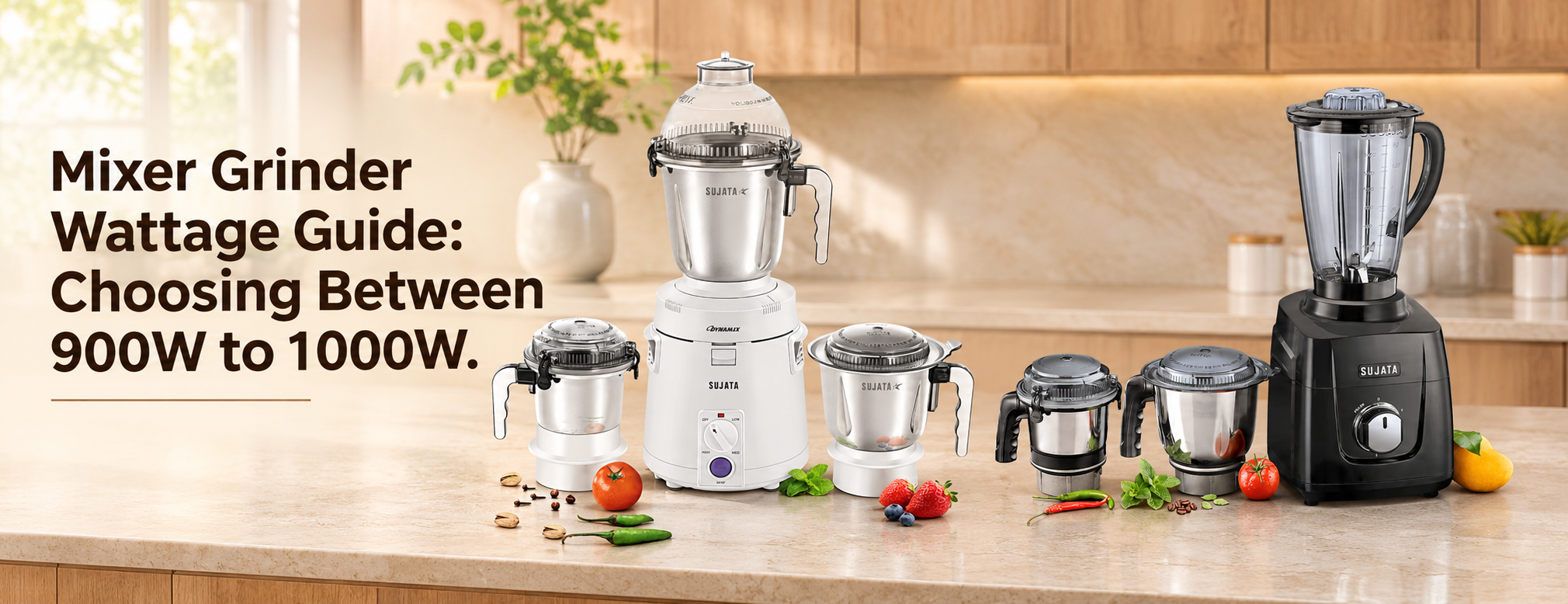
Higher-wattage mixer grinders, those in the 900W to 1000W range, are specifically engineered for kitchens where grinding demands are consistently heavy. Large families, frequent bulk cooking, professional home cooks, and households where fresh grinding is a daily necessity all benefit from the motor capacity and resilience that this wattage range provides.
A mixer grinder 1000 watts is built to handle continuous, high-load cycles without thermal buildup, to maintain grinding consistency across large batches, and to sustain this level of performance reliably over years of regular use.
The Right Way to Think About Mixer Grinder Wattage
The most common mistake buyers make is treating mixer grinder wattage as a performance rank, that more is always better, or that less is more economical. Neither framing captures the full picture.
Sujata’s range of mixer grinders is built around this understanding, powerful motors, precision-engineered for the demands of Indian cooking, designed to deliver consistent grinding results with low maintenance and long operational life. The wattage specification is one part of that commitment. The engineering behind it is the rest.
Durable performance starts with the right decision. Choose a motor built for your kitchen’s real needs, and built to last.
FAQs
1. Is a 1000W mixer grinder better than a 900W mixer grinder?
Not necessarily. A 1000W mixer grinder may be suitable for kitchens with frequent heavy grinding requirements, while a 900W model can meet many everyday cooking needs. The right choice depends on your ingredients, cooking frequency, motor construction and overall appliance specifications.
2. Which mixer grinder wattage is suitable for Indian cooking?
A 900W or 1000W mixer grinder can be suitable for Indian cooking, particularly for regular masala grinding, chutneys and batter preparation. Consider the type and quantity of ingredients you process most often before selecting a model.
3. Does a higher-wattage mixer grinder consume more electricity?
A higher-wattage mixer grinder has a higher rated power draw when operating at its rated conditions. However, actual electricity consumption also depends on how long and how frequently you use it, along with the load being processed.
4. What should I check besides wattage when buying a mixer grinder?
Look at motor construction, RPM, jar design, blade quality, build quality and heat management. For example, Sujata’s mixer grinder range includes 900W models such as DYNAMIX and SUPERMIX, as well as 1000W models such as MG01, MG02 and MG03. Comparing these specifications can help you choose a model suited to your kitchen’s needs.